I think they are more properly called tortoiseshell.
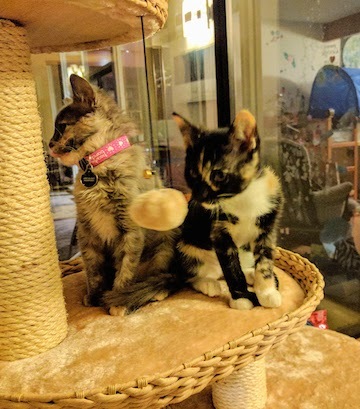
The difference is that calicos have distinct patches of white, black, and orange, whereas torties are mottled all over and have little or no white. I think that Nicky (the kitten on the right) might be called "tortoiseshell and white" because she has a white chest and white socks on all four feet, but otherwise her colors are all intermingled. The other kitten, Quin, would probably be called a "blue/cream tortoiseshell."
Both tortoiseshell and calico cats are nearly always female because to have either color pattern the cat has to have two different alleles of a coat-color gene found on the X chromosome. Calico and tortoiseshell patterns can only occur in male cats when they have two X chromosomes (XXY also known as Klinefelter Syndrome).


![[personal profile]](https://www.dreamwidth.org/img/silk/identity/user.png) branchandroot
branchandroot
no subject
Date: 2017-01-03 12:49 pm (UTC)no subject
Date: 2017-01-03 11:52 pm (UTC)no subject
Date: 2017-01-04 02:10 am (UTC)no subject
Date: 2017-01-04 04:24 am (UTC)The difference is that calicos have distinct patches of white, black, and orange, whereas torties are mottled all over and have little or no white. I think that Nicky (the kitten on the right) might be called "tortoiseshell and white" because she has a white chest and white socks on all four feet, but otherwise her colors are all intermingled. The other kitten, Quin, would probably be called a "blue/cream tortoiseshell."
Both tortoiseshell and calico cats are nearly always female because to have either color pattern the cat has to have two different alleles of a coat-color gene found on the X chromosome. Calico and tortoiseshell patterns can only occur in male cats when they have two X chromosomes (XXY also known as Klinefelter Syndrome).
Anyway, they are adorbs!
no subject
Date: 2017-01-04 04:54 am (UTC)no subject
Date: 2017-01-04 02:40 am (UTC)no subject
Date: 2017-01-04 04:32 am (UTC)